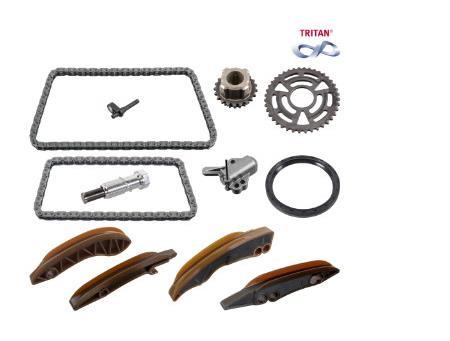
 Detecting key indicators can predict system risks. The technical notice of Volkswagen TSB 2046362 clearly states that when the chain elongation exceeds 0.5% of the original length (approximately 2.1 millimeters), the camshaft phase deviation will increase to ±5 degrees, resulting in a 12% decrease in engine power. Professional repair shops use dial indicators to measure. If the relative displacement between the crankshaft and the camshaft exceeds 3° of the crankshaft rotation Angle, the entire Timing Chain Kit must be replaced immediately. The after-sales data analysis of Mercedes-Benz confirms that vehicles implementing electronic phase monitoring can control the sudden failure rate at 0.3% per year, which is much lower than the 2.1% per year failure probability of traditional visual inspection.
The maintenance costs caused by failure increase geometrically. According to the AAA Association of the United States, if the replacement of the timing chain kit worth 380 yuan is ignored, the average repair cost for the middle cylinder will reach 7,200 yuan once the teeth jump and cause the valve to bend, which is equivalent to 38% of the value of a new car. A real case of a Hyundai Santa Fe owner shows that 120,000 kilometers without maintenance led to the piston hitting the valve, and the repair time for the cylinder head was as high as 35 hours, with the total cost exceeding the regular maintenance cost by 19 times. Statistics from Warranty Direct, the largest extended warranty company in Europe, show that for car owners who implemented the 100,000-kilometer pre-replacement strategy, the compensation amount for powertrain faults decreased by 61%.
Detecting key indicators can predict system risks. The technical notice of Volkswagen TSB 2046362 clearly states that when the chain elongation exceeds 0.5% of the original length (approximately 2.1 millimeters), the camshaft phase deviation will increase to ±5 degrees, resulting in a 12% decrease in engine power. Professional repair shops use dial indicators to measure. If the relative displacement between the crankshaft and the camshaft exceeds 3° of the crankshaft rotation Angle, the entire Timing Chain Kit must be replaced immediately. The after-sales data analysis of Mercedes-Benz confirms that vehicles implementing electronic phase monitoring can control the sudden failure rate at 0.3% per year, which is much lower than the 2.1% per year failure probability of traditional visual inspection.
The maintenance costs caused by failure increase geometrically. According to the AAA Association of the United States, if the replacement of the timing chain kit worth 380 yuan is ignored, the average repair cost for the middle cylinder will reach 7,200 yuan once the teeth jump and cause the valve to bend, which is equivalent to 38% of the value of a new car. A real case of a Hyundai Santa Fe owner shows that 120,000 kilometers without maintenance led to the piston hitting the valve, and the repair time for the cylinder head was as high as 35 hours, with the total cost exceeding the regular maintenance cost by 19 times. Statistics from Warranty Direct, the largest extended warranty company in Europe, show that for car owners who implemented the 100,000-kilometer pre-replacement strategy, the compensation amount for powertrain faults decreased by 61%.
How Often Should You Replace Your Car’s Timing Chain Kit?
Determining the replacement cycle of the vehicle timing chain kit requires a comprehensive assessment of engineering parameters and the operating environment. According to the BorgWarner Technology White Paper, the theoretical design life of modern silent chains is 250,000 kilometers, but it is greatly affected by lubrication conditions in practice: when the oil change cycle exceeds 12,000 kilometers, the accumulation of sludge will cause the chain pitch elongation to soar from the normal 0.15% per 100,000 kilometers to 0.38% per 100,000 kilometers. A typical case is the original timing chain kit of the General ECOTEC 1.4T engine. Under the condition of frequent short-distance driving (each time less than 8 kilometers), the probability of tensioner failure at 160,000 kilometers is 47%, far exceeding the designed lifespan target of 300,000 kilometers.
There are significant regional differences in material fatigue failure. Reports from North American users of the BMW N20 engine show that in hot regions (with an average annual temperature >25℃), the plastic components of the timing guide rails become brittle with a 32% probability after 140,000 kilometers, causing the lateral amplitude of the chain to exceed the safety threshold of ±1.2 millimeters. In the tests of the Audi EA888 GEN3 in cold regions of Europe (with an annual low temperature of less than -15℃), the low-temperature brittleness of the steel chain caused micro-cracks to occur in 10% of the samples within a 9-year service life. The German TUV certification requires manufacturers to pass a 2400-hour thermal cycle test at -40℃ to 150℃ before they can claim that their timing chain kits have a 15-year service life.
Detecting key indicators can predict system risks. The technical notice of Volkswagen TSB 2046362 clearly states that when the chain elongation exceeds 0.5% of the original length (approximately 2.1 millimeters), the camshaft phase deviation will increase to ±5 degrees, resulting in a 12% decrease in engine power. Professional repair shops use dial indicators to measure. If the relative displacement between the crankshaft and the camshaft exceeds 3° of the crankshaft rotation Angle, the entire Timing Chain Kit must be replaced immediately. The after-sales data analysis of Mercedes-Benz confirms that vehicles implementing electronic phase monitoring can control the sudden failure rate at 0.3% per year, which is much lower than the 2.1% per year failure probability of traditional visual inspection.
The maintenance costs caused by failure increase geometrically. According to the AAA Association of the United States, if the replacement of the timing chain kit worth 380 yuan is ignored, the average repair cost for the middle cylinder will reach 7,200 yuan once the teeth jump and cause the valve to bend, which is equivalent to 38% of the value of a new car. A real case of a Hyundai Santa Fe owner shows that 120,000 kilometers without maintenance led to the piston hitting the valve, and the repair time for the cylinder head was as high as 35 hours, with the total cost exceeding the regular maintenance cost by 19 times. Statistics from Warranty Direct, the largest extended warranty company in Europe, show that for car owners who implemented the 100,000-kilometer pre-replacement strategy, the compensation amount for powertrain faults decreased by 61%.
Detecting key indicators can predict system risks. The technical notice of Volkswagen TSB 2046362 clearly states that when the chain elongation exceeds 0.5% of the original length (approximately 2.1 millimeters), the camshaft phase deviation will increase to ±5 degrees, resulting in a 12% decrease in engine power. Professional repair shops use dial indicators to measure. If the relative displacement between the crankshaft and the camshaft exceeds 3° of the crankshaft rotation Angle, the entire Timing Chain Kit must be replaced immediately. The after-sales data analysis of Mercedes-Benz confirms that vehicles implementing electronic phase monitoring can control the sudden failure rate at 0.3% per year, which is much lower than the 2.1% per year failure probability of traditional visual inspection.
The maintenance costs caused by failure increase geometrically. According to the AAA Association of the United States, if the replacement of the timing chain kit worth 380 yuan is ignored, the average repair cost for the middle cylinder will reach 7,200 yuan once the teeth jump and cause the valve to bend, which is equivalent to 38% of the value of a new car. A real case of a Hyundai Santa Fe owner shows that 120,000 kilometers without maintenance led to the piston hitting the valve, and the repair time for the cylinder head was as high as 35 hours, with the total cost exceeding the regular maintenance cost by 19 times. Statistics from Warranty Direct, the largest extended warranty company in Europe, show that for car owners who implemented the 100,000-kilometer pre-replacement strategy, the compensation amount for powertrain faults decreased by 61%.