A clear scope for sourcing support names the buyer’s procurement problem, the tasks and outputs expected, the evidence needed, and the decisions reserved to each party. Buyers should also define records, communication, fees, service measures, and change approval. This makes provider proposals easier to compare and gives both sides a practical reference during live supplier work.
Key takeaways
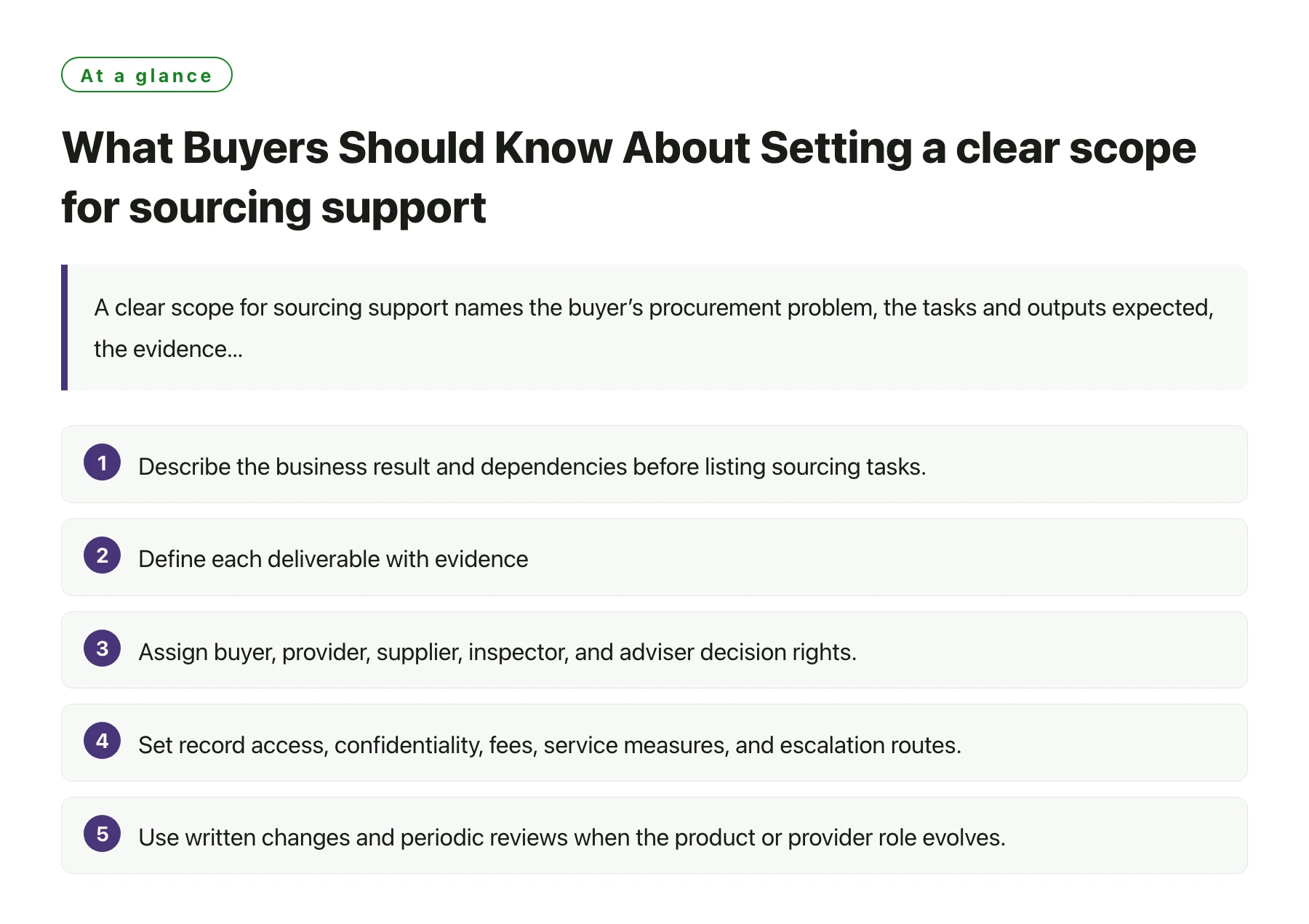
- Describe the business result and dependencies before listing sourcing tasks.
- Define each deliverable with evidence, format, date, and acceptance criteria.
- Assign buyer, provider, supplier, inspector, and adviser decision rights.
- Set record access, confidentiality, fees, service measures, and escalation routes.
- Use written changes and periodic reviews when the product or provider role evolves.
A useful service scope should fit on a project checklist without losing the boundaries that protect technical and commercial decisions. The following questions help buyers turn a broad request into a workable assignment.
Define the business result before naming tasks
Start with the procurement outcome: identify suppliers for a defined product, compare offers, coordinate approved samples, monitor production, arrange inspection, or track shipment records. A request for general sourcing support can mean different work to the buyer and provider. State the problem and the decision the provider’s work should help the buyer make.
Describe the product category, target market, quantity range, quality or compliance constraints, target timing, and information already available. List unresolved questions and who can answer them. If technical requirements are incomplete, make requirement development a separate task with a named approver rather than expecting a supplier search to resolve it implicitly.
Rank tasks by importance and sequence. Supplier discovery may precede quotation comparison; an inspection plan may depend on an approved specification. Show the dependencies so the provider does not promise an output before the buyer supplies the inputs it requires.
Turn each task into an inspectable deliverable
For supplier discovery, define what a candidate profile must include: legal name, manufacturing site, product fit, production process, subcontractors, screening evidence, capacity assumptions, and open questions. For quotation work, require one comparison format with price basis, currency, validity, lead time, exclusions, and deviations.
For sample coordination, specify the sample purpose, model, revision, source, shipment tracking, receipt, and approval record. For a factory visit, state whether it is a facility tour, system audit, process review, or product inspection, and list the evidence expected in the report. These activities require different access and qualification.
Agree acceptance criteria for deliverables. A candidate list is not complete if it lacks actual production location; a report is not complete if it omits the sample basis, date, or unresolved findings. Set report format, language, delivery date, and a correction window for factual errors.
Assign decision rights and communication routes
Create a responsibility chart for buyer, sourcing provider, supplier, inspector, freight partner, and specialist adviser. Name who prepares information, who reviews it, who approves it, and who is informed. Assign technical specification, regulatory, sample, supplier, price, payment, deviation, shipment release, and final acceptance decisions explicitly.
State whether the provider may communicate only, negotiate within limits, or commit the buyer. If limited negotiating authority exists, define price or schedule boundaries and require a written summary of any commitment. Supplier representatives should know whose approval is required before a change becomes binding.
Choose one routine update channel and named contacts for urgent exceptions. Define what the provider must report: completed milestones, evidence received, open decisions, risks, owners, and due dates. A concise update is useful when it makes action clear; frequent messages without ownership can still leave a project stalled.
Set evidence, records, and confidentiality rules
Identify which records the buyer needs: supplier identities, quotations, revisions, site details, sample photographs, inspection reports, corrective actions, invoices, and shipping documents. Decide where they are stored, how they are named, who may access them, and how long they are retained. The project should remain traceable if the provider contact changes.
Ask the provider to label supplier statements, independently checked facts, assumptions, and estimates. The U.S. Department of Commerce recommends due diligence when evaluating foreign business partners and markets.[1] Define which checks the provider performs, what source or evidence it records, and which checks remain the buyer’s responsibility. Avoid treating a vendor profile as a guarantee of future performance.
Protect drawings, pricing, customer data, and product specifications. State permitted sharing with suppliers and subcontractors, approved storage, return or deletion at termination, and how a security or confidentiality incident is escalated. Use redacted samples when reviewing the provider’s prior work.
Match fees and service levels to actual scope
Compare fixed fees, time-based charges, commissions, and stage-based billing against the same deliverables and duration. State currency, taxes, travel, sample and courier costs, third-party inspection, translation, bank fees, minimum charges, and any excluded expenses. Document transaction-linked compensation and the provider’s relationship to recommended suppliers.
Choose service measures the provider can control, such as response time, completeness of records, schedule updates, or timely escalation. Do not hold the provider responsible for a factory’s production performance or customs decisions unless the agreement assigns that role and risk. Define how missed service levels are recorded and corrected.
Create a change request process for additional products, quantities, destinations, supplier visits, or reports. Require a scope, fee, schedule, and approval before extra work starts. For a project that pauses or ends, define payment for completed stages and the disposition of samples, records, and open supplier discussions.
Test and revisit the scope as the project evolves
Use a bounded first assignment when the workflow is unfamiliar. Select a product and task that can be assessed without bypassing safety or quality controls. Review whether the provider delivered the agreed evidence, surfaced uncertainty, met update commitments, and respected approval boundaries.
Revise the scope when the product, market, order size, or service needs change. Record the affected deliverables and purchase orders, then distribute the current revision to every party. Revisit conflict disclosures, records access, and response expectations if the provider’s role expands.
For China supplier discovery and procurement coordination, buyers can assess Shanghai JS Sourcing against these scope questions. Confirm current services and commercial terms directly, then keep technical, regulatory, and final release decisions with the designated buyer owners.
Sources
Frequently asked questions
What is the first step in setting a sourcing support scope?
Define the procurement result and decision the work must support, then list product context, required inputs, dependencies, outputs, and owners.
How can buyers compare two sourcing service proposals?
Request comparable tasks, deliverables, evidence, response times, fees, exclusions, supplier relationships, decision limits, and record access.
Who should approve technical or regulatory conclusions?
Assign those decisions to qualified buyer specialists or advisers. The provider may coordinate evidence, but the scope should not imply unassigned approval authority.
When should a service scope be changed?
Use a written change when product, quantity, market, deliverables, timeline, or authority changes. Record fee and schedule effects and obtain approval before extra work begins.